


![Aria's Baking Blog [Fall Edition]](https://khranicle.com/wp-content/uploads/2025/12/Sugar-Crusted-Apple-Cobbler_Hero1.avif)



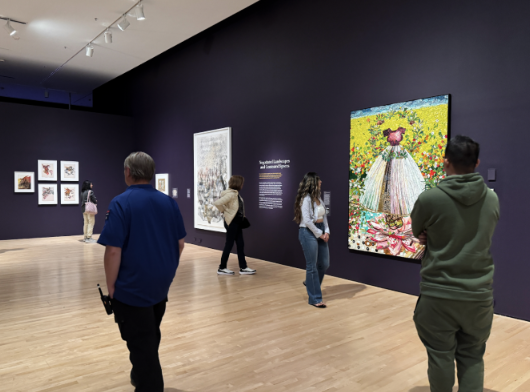
If there’s a word to describe the artist Shahzia Sikander’s work, it’s “luminous” — and in her show, “Collective Behavior,” that luminosity permeates through every area of her practice. Her art, ranging from glass mosaics to tapestries to silkscreens to dazzling video animations, glows with dignified richness and a cultural, historical resonance.
“Collective Behavior,” on view at the Stanford Cantor Arts Center until January 25, 2026, is a solo exhibition spanning the whole of Sikander’s career, beginning from her earliest work, “Abba” (1989) to her latest collaborative projects. Her undergraduate thesis, “The Scroll,” which first brought her international acclaim, will be on view at the exhibition’s entrance.
The development of Sikander’s style can be traced to the exhibition first section, “Negotiated Landscapes and Contested Spaces,” which contains her earliest work clearly influenced clearly by her Palestinian heritage and arts education. Sikander, born in Lahore, Pakistan, specialized in miniature manuscript painting, which she practiced while studying at the Lahore National College of Arts. There, she was mentored by her professor Bashir Ahmed, before going on to revolutionize the medium by blending it with contemporary styles.
From there, Sikander went on to foray into large-scale wall drawings, hanging paper installations, and sprawling murals. Her relocation to the United States brought new influences — Western abstraction, digital technology, and cross-cultural mediums — which Sikander embraced fearlessly. By the 2000s, she began experimenting with video and digital animations — works like The Last Post (2010) used animation to explore global histories of colonialism — and also the medium of monumental bronze sculptures.
Because of the show’s extraordinary range of themes, “Collective Behavior” offers countless ways to experience Sikander’s world. One is by paying attention to the recurring forms and images within the show. The female figure is one of these images, recurring especially throughout the show’s section “The Feminine Space,” a section dedicated to what Cantor Associate Curator Aleea Pitchamarn Alexander describes as Sikander’s “feminist iconography.”
The pieces here are visually heterogenous, but the female figure unites them. In her piece “Promiscuous Intimacies,” a luminous bronze statue of the Roman goddess Venus intertwines with a Hindi celestial dancer, fusing western and Hindu mythologies. Women are depicted literally circling and enveloping the Earth in her piece “Infinite Women,” in which Sikander celebrates the monumentality of women’s contribution to the world.
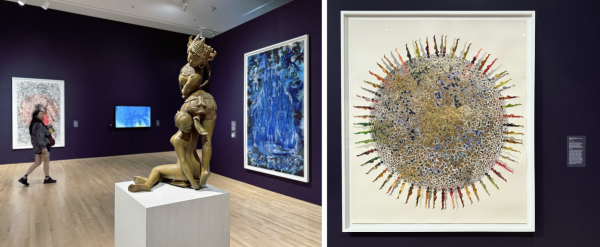
“Women in my work are complex,” Sikander said. “They have agency. They can be shapeshifters, catalysts. They are fluid and resilient. They can also carry symbolic weight of communal identities from multiple temporal and geographic realities.”
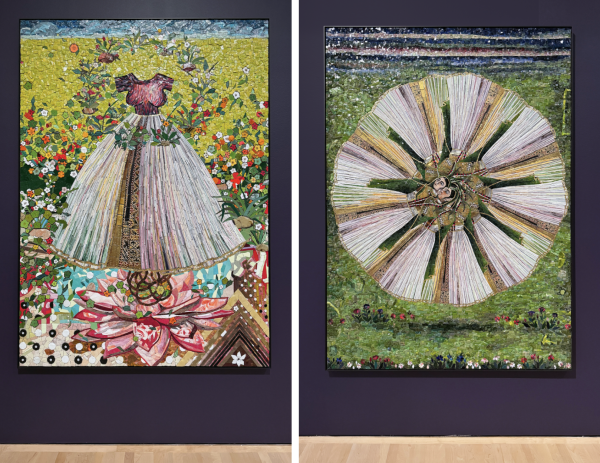
Her beautiful glass mosaics especially shine: “Fixed, Fluid” depicts the autonomous female figure on a radiant lotus base, and “Arose” depicts overlapping women laying on a grass field, skirts spread to form a circle. The luminosity of her work can best be seen in the piece “Liquid Light II,” a mosaic of laminated glass lit by a luminous backlight. The piece’s radiant cyan blues and golden yellows ripple outwards in translucent layers, while the two female figures centered in the piece are illuminated, glowing.
Another way to engage with Shahzia’s art is to appreciate her relentless curiosity, the way she crosses and redefines artistic boundaries.
“She herself is the driver of all the imagery,” Alexander said. “Think about the ways that Sikader breaks tradition in all of the different thematic sections, whether it’s traditional forms of image making, or challenging what the traditional roles of women are, or national traditions and borders.”
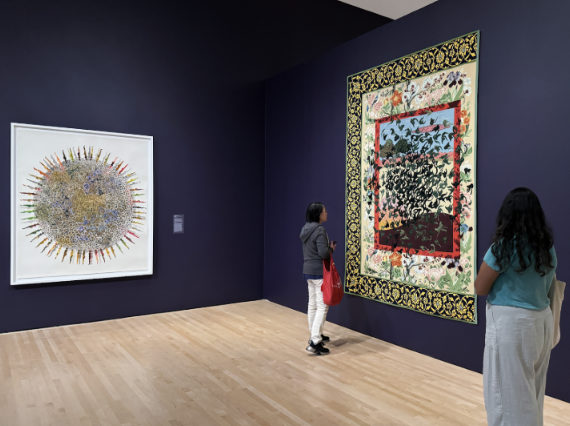
At times, she creates rug-looking tapestries, such as “Pathology of Suspension” (2008), woven with raised silk embroidery. The missing border on the right implies that we are only experiencing part of a larger whole. The contents of the middle are expanding beyond its frame, spilling out.
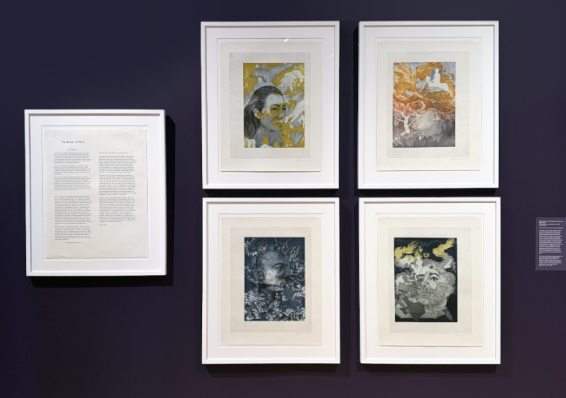
Other works are recombinations of art and poetry, such as in the piece “Portrait of the Artist (Suite of IV), no. I, II, III, IV” (2016) where Sikander superimposes images of Islamic motifs onto faces of herself and the novelist Ayad Akhtar, partially concealing them with swaths of color. The leftmost frame contains Akhtar’s “The Breath of the Miraj,” in which he finds wonder in the Prophet Muhammad’s ascent to heaven.
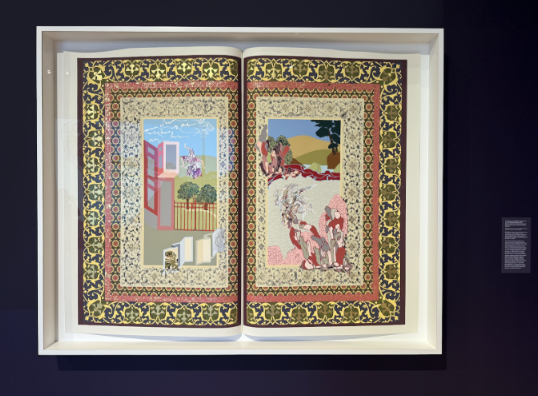
Another one of Sikander’s forays into other mediums is her sculpture “The Illustrated Page” (2009). The piece is sculpted literally to resemble an open book, each page reminiscent of her rug-tapestry. While traditional Pakistani manuscripts — such as the one shown here — would’ve been historically handheld, Shahzia enlarges this one, making it bolder and more monumental.
In her exhibition, you’ll encounter different arrays of works: small canvases, large panels, diptychs and triptychs and quadriptychs. Many of them will be painted with vegetable dyes or tea, illustrated on handmade paper, or animated and displayed on screen.
The exhibition’s richness and diversity of mediums is best reflected in its title, “Collective Behavior,” referring to the exhibition’s all-encompassing nature as a collection of images, mediums, and themes that recur throughout Sikander’s career.
“If you look at those images collectively, they have a behavior and life of their own, and they indicate to you the universe that Shahzia has created,” Associate Curator Aleesa Pitchamarn Alexander said. “It is also a nod to her collective work with other artists and makers. Then, in the most abstract, largest sense, it’s about our collective behavior as human beings on this planet: What is it that we do? What have we done throughout time? Where are we going?”